

Many people know and love Mary Poppins, but far fewer know about the woman who created her. What drew you to P.L. Travers’ story?
The initial spark for ‘Paper Stars’ was ignited when I discovered (through the beautiful film ‘Saving Mr Banks’) that P.L. Travers was Australian. As a team of Australian storytellers, we wanted to share and celebrate this little-known fact, with Australia, and the world!
I’m also a big believer that there are certain stories begging to be ‘musicalised’, and the expansiveness of P.L. Travers’ imagination and world-building felt to me like it wanted to soar into song and dance. I truly find Pamela such a fascinating and complex character to follow onstage for 90 minutes. She experienced significant loss and sadness as a young child – with the death of her father when she was seven and her mother’s subsequent mental health struggles – and as she so eloquently expressed, “sorrow lies like a heartbeat behind everything I have ever written”.
Ultimately, I was drawn to the idea of making a musical made up of both light and shadow, melancholy and magic.
The show is inspired by real events but told through an imaginative lens. How did you balance historical truth with theatrical magic?
Research informed a major part of the writing process of ‘Paper Stars’ – I spent days poring over the P.L. Travers’ archives which are kept at the State Library of NSW. We drew inspiration from the many personal letters and academic articles she wrote throughout her illustrious career and of course tried to infuse our musical with the spirit of the ‘Mary Poppins’ books.
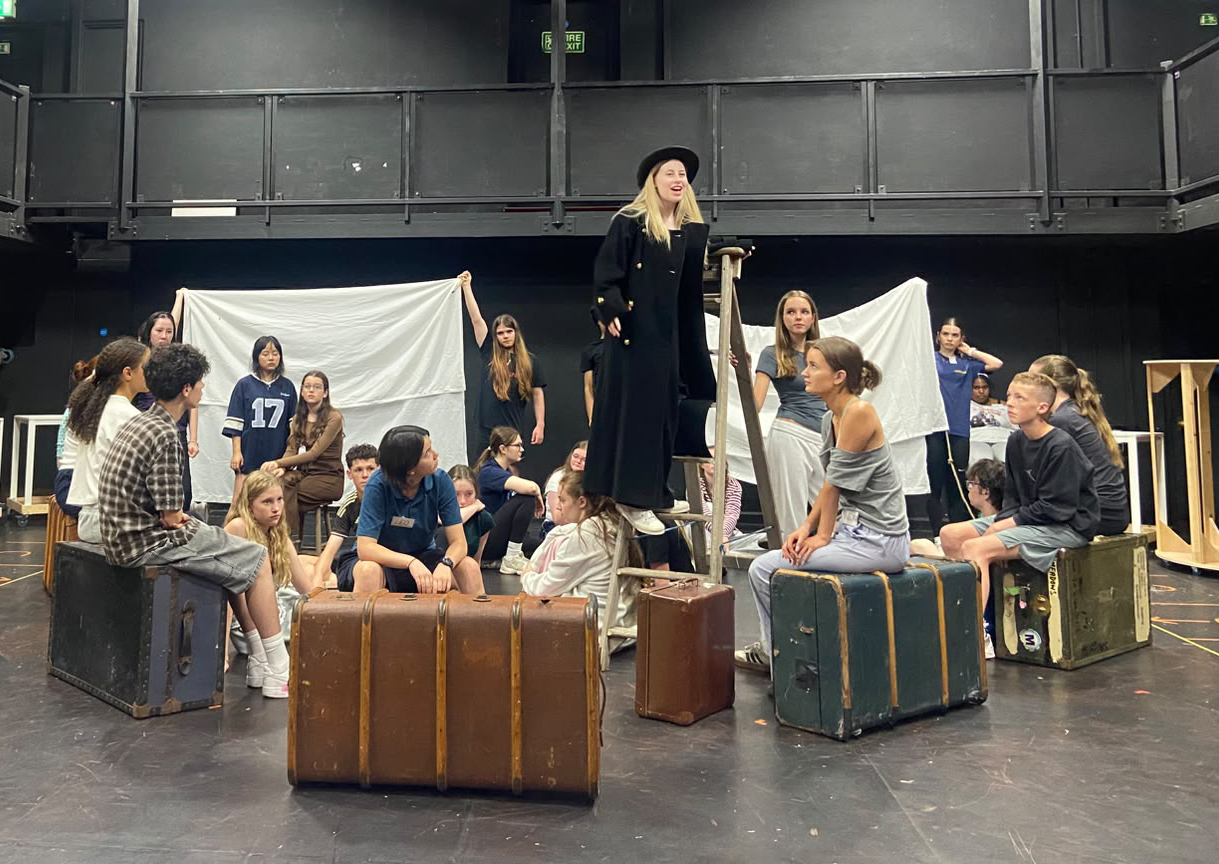
However, there were holes in our knowledge, and moments in her life that we had to “colour in” with our own imaginations. As they say, you should never let truth get in the way of a good story! Our rehearsal process is grounded in the principles of play, possibility, and ‘may the best idea win’, so the show will very much be a by-product of all the clever minds making it.
Without giving too much away, are there moments in the show that fans of Mary Poppins might find particularly special?
One of my favourite moments of the show is the ‘genesis’ moment of ‘Mary Poppins’, which first appeared as a short story in a newspaper before it was published as a complete book eight years later.
Anecdotally, we know that the character of Mary Poppins was inspired by Pamela’s rather prim and proper Aunt Ellie. In our version of the story, the arrival of a letter from Aunt Ellie combined with a visit from a paper boy called William, provides Pamela with the creative spark for a story called ‘Mary Poppins and the Matchman’.
Luke has written the most glorious music for this part of the show, which provides lots of inspiration for creative staging! I think Mary Poppins fans will enjoy this moment…
Paper Stars is being brought to life by young performers and musicians from across the UK. What excites you most about working with a company of talented young people?
P.L. Travers was only 25 when she set sail to London with a little suitcase and a big dream, so it feels really lovely to be bringing her story to life with a group of young performers and musicians. I’m excited to invite their sparky imaginations and creativity into the worldbuilding and see what still resonates for them in the ‘Mary Poppins’ story almost 100 years after it was first written.
I’m also just so honoured to be working with British Youth Music Theatre as an organisation which champions the importance of making theatre with and for the next generation of storytellers and fostering their passion and talent.
We have seen many musicals using pop style music, what makes ‘Paper Stars’ different from the others?
‘Paper Stars’ doesn’t exclusively feature pop music, but it’s certainly a flavour within the overall musical palette. Pop is primarily used to distinguish the loud, exciting, modern world of London from the “fetid backwater” of early 1900s Australia, which is established early in the show through a folkier style. The pop songs are also attached to one of the spunkiest characters in the show, Madge Burnand, who plays a major part in transforming the gawky Australian Lyndon Goff, into the P.L. Travers of ‘Mary Poppins’ fame.
How do you hope audiences feel as they leave the theatre after seeing Paper Stars?
I hope audiences will feel the marshy quagmire of emotions I feel after Mary Poppins leaves the Banks children! In other words, snotty-nosed but with a smile on their face.
My favourite kind of story is one that makes you laugh, breaks your heart, and somehow puts you back together again. I hope people leave ‘Paper Stars’ feeling fully human – alive to their grief, their hopes, their dreams, and the possibility of everyday magic.
Click here to book tickets to see Paper Stars at Barnfield Theatre, Exeter, this weekend!